


The Challenge
TEAM Software had been an established leader in the Workforce Management space for over 30 years. However, their primary product offerings had grown incrementally over that timeframe. They had many essential capabilities, but had become bloated, complex, and cumbersome to use.
With the competitive landscape growing stronger by the day, TEAM Software was desperate to transform themselves to retain and better serve their loyal customers.

The Plan

My agency team’s mandate was to propose a new product from the ground-up. We had 8 weeks to speak with customers, map out the problem space, navigation possible solutions, and weave them together in to a research-based visiontype that would serve as the foundation driving their new direction.
Setting a Foundation
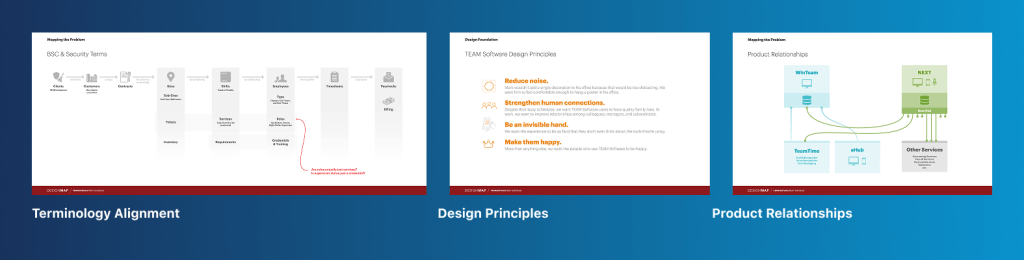
As with any domain, we needed to align on the basics from the start. This included terminology, current products and how they relate to this transformation plan, and design principles.
Understanding the Users
The people using these tools were not your typical desk-bound SaaS users. To understand their realities, we embedded ourselves with 10-15 users across several companies, across multiple roles, and were awakened to their grim realities.

We learned so much. Many still relied on massive stacks of paper and sticky notes for 80% of their work. Many were on call for emergencies at nearly all hours of the day. They bounced around from site-to-site, triaging emergencies of all kinds. They were all burnt out, overworked, and equipped with technology that barely met their needs.
Building the Personas
With the contextual user research in hand, we now needed to synthesize it as a new set of personas. In a 1-day intensive workshop, we brought all stakeholders together to represent a set of users and cluster them by similarity of roles and needs.
This workshop was an incredible moment of empathy-building for the team, and internally, had the effect of bringing people together for an exciting activity.

The output was six personas that thoroughly represented the wide array of needs we aimed to serve. We wanted the empathy from the workshop to persist beyond the workshop, so we formatted the personas as posters that could be hung in the hallways of their office — as if the customers themselves were in their presence.
Building Stories & Ideation
We then moved on to building an end-to-end story. This was challenging, because Workforce Management encapsulates such a wide variety of tasks – including payroll, scheduling, site management, incident management, resource management, and more.
Then, we went wide in sketching out divergent ideas for how to serve each moment in that story. We worked closely with the team to discuss ideas and brainstorm together.

Navigating Options
With so many ideas in hand, we needed a way to navigate them. We identified some factors that were important to our personas, and mapped various design directions to those.
While TEAM Software didn’t currently offer a mobile app solution, the reliance on traveling and site-management made that an important consideration. A Day/Week/Month frequency analysis by scenario helped us understand the priorities between mobile and desktop devices.

Screenflows & Wireframes
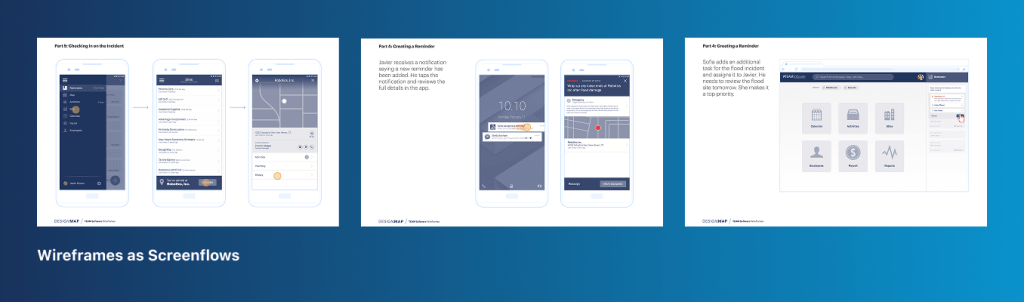
Once we decided on the right directions with the team, we began honing in on the details of each screenflow and screen surface.
The story, combined with the sketches, served as the foundation for this — it was really a lot of nose-to-the-grinder kind of work, with much of the team alignment already set in place.
Modernizing the Brand
The product has existed as a native Windows app, and thus never had to face the question of visual design and branding (beyond the logo).
We had an incredible team of visual designers on hand who cooked up 3 compelling directions. It was a hard decision for everybody, but they guided the stakeholders through the options and towards a decision.
As I churned out wireframes, the visual designers worked their magic and produced some epic and beautiful screens to bring them to life.

Moments of Delight
After being presented an artist team’s best work, Walt Disney had a phrase he’d always ask of his team: “Plus it.” Take something that you’re already proud of, that feels complete, and add more magic to it.
We found numerous ways to do this, such as proposing a Jetsons-inspired AI Agent named “Rosie” (yes, before LLMs were cool), and introducing what Jony Ive would called a “fiddle factor” to the mobile app home screen.
Crafting the Vision
Once the visual designers created the screens we needed, my job was to weave them together to tell the final story as a visiontype.
Our plan was to share this visiontype at an upcoming conference — showing customers that positive change was on the horizon, and bring tangible excitement to the team.
Final Customer Feedback
Our team attended the conference that summer and hosted a booth and presentation for customers around the team’s vision.
To cap off this engagement, we qualitatively collected and distilled feedback directly from customers at the conference, in a second round of research.
To say that the excitement was through the roof would be an understatement.
Where are they now?
After many years, I recently checked on their website to see where they landed. The team found a way to bring this vision to life, stay competitive in ways that built on the foundation that we laid together.
